Receipts to Reports in Seconds: AI Expense Tracking That Pays for Itself
You find a crumpled receipt in your jacket pocket from three weeks ago. $47 at a gas station. No idea which client visit it was for. You stuff it in a desk drawer with the others and tell yourself you'll sort it out at tax time.
This is how most small businesses handle expenses. It doesn't work.
The Receipt Problem by the Numbers
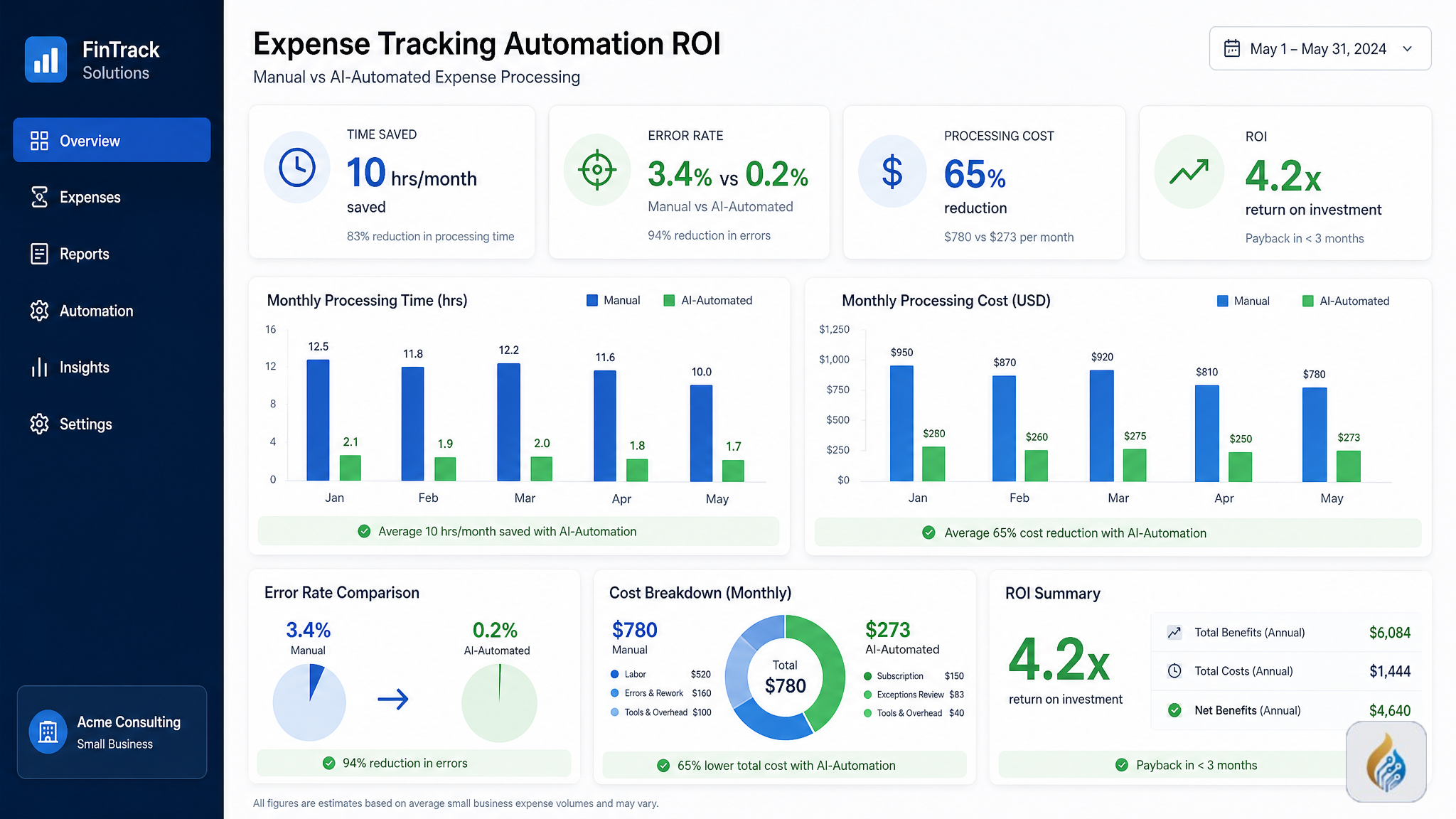
The average small business processes 25–40 expense reports per month. Each one takes 20 minutes of manual work — gathering receipts, entering line items, assigning categories, flagging exceptions, getting approvals. That's 8 to 13 hours a month spent on data entry that should take seconds.
Then there are errors. Manual expense entry has an error rate around 3.4%, according to the Institute of Finance and Management. That means roughly one in every 30 entries is wrong — wrong category, wrong amount, duplicate charge, missing receipt. Someone has to find and fix each one. Add another 2–3 hours per month for corrections and disputes.
And late submissions. Employees in companies without automated expense systems submit reports an average of 5 days late. You're floating cash out of pocket for almost a week before it hits the books. For a business managing tight cash flow, that lag hurts.
What AI Expense Tracking Actually Does
AI-powered expense tracking replaces the manual cycle with three automated steps:
Capture. Snap a photo of a receipt or forward an email confirmation. The AI reads the merchant, amount, date, and tax — no typing. It works with paper receipts, digital receipts, and photo captures of handwritten totals.
Categorize. The AI assigns each expense to the right category based on merchant data and spending patterns. A charge at a hotel maps to travel. Office supply store maps to operations. It learns your chart of accounts and gets more accurate over time.
Report. Expenses flow into real-time reports by category, department, project, or client. Managers see spending as it happens, not weeks later. Reimbursement requests generate automatically with all the documentation attached.
No spreadsheets. No chasing missing receipts. No manually assigning "meals" vs "travel meals" for the hundredth time.
The ROI Math
Let's run the numbers for a 20-person business with 30 expense reports per month:
Time saved on entry: 30 reports × 20 minutes = 10 hours/month. At $35/hour loaded admin cost, that's $350/month or $4,200/year. - error correction time saved: At 3.4% error rate on ~150 line items/month, roughly 5 errors need fixing each month. Each takes 15 minutes. That's 1.25 hours/month = $525/year. - faster reimbursement: Cutting the 5-day submission lag to same-day means better cash flow visibility and fewer employee complaints. For a business with $8,000/month in reimbursable expenses, even a 3-day improvement in float is real working capital flexibility. - tax readiness: Clean, categorized, receipt-attached expense records year-round means your accountant spends less time reconstructing your books at tax season. Typical savings: $500–$1,500 per year on reduced accounting fees.
Total estimated annual savings: $5,225 to $6,225. And that's before counting the cash flow benefit of faster reporting.
For a business currently paying someone to do this manually, the AI setup covers its own cost within the first few months.
We Do It for You
You don't need to evaluate platforms, configure categorization rules, or train a system on your chart of accounts. Aurumflare sets up the entire expense tracking pipeline and manages it going forward. Your team snaps receipts. The reports show up. That's it.
If you're still sorting receipts at tax time — or paying someone else to — talk to us.
See how AI automation could work for your business
Book a free 30-minute assessment — no pitch, just answers.
Book a Free Assessment